
|
News October 10, 2023
|
International Society for Environmental Epidemiology Asia and Western Pacific Chapter (ISEE-AWPC 2024), Kota Kinabalu, Sabah, Malaysia
June 23 – 26, 2024
Agenda: iseeawpc2024.jpg
Deadline for abstracts: Oct 15 – Dec 21, 2023
June 23 – 26, 2024
Agenda: iseeawpc2024.jpg
Deadline for abstracts: Oct 15 – Dec 21, 2023
|
News August 19, 2023
|
2023 International Symposium of Precision Environmental Medicine (ISPEM)
Birth Cohort Consortium of Asia (BiCCA) Workshop and Reunion
September 15 – 19, 2023
Agenda: ISPEM 2023 BiCCA Workshop and Reunion (updated 0914)
Registration
Birth Cohort Consortium of Asia (BiCCA) Workshop and Reunion
September 15 – 19, 2023
Agenda: ISPEM 2023 BiCCA Workshop and Reunion (updated 0914)
Registration
|
News May 20, 2023
|
35th Annual Conference of the International Society for Environmental Epidemiology (ISEE 2023), Kaohsiung, Taiwan
September 17 – 21, 2023
Website: https://www.iseeconference.org/
Extended Deadline for abstracts: March 23, 2023
September 17 – 21, 2023
Website: https://www.iseeconference.org/
Extended Deadline for abstracts: March 23, 2023
|
News Jan 26, 2022
|
International Society for Environmental Epidemiology Asia and Western Pacific Chapter & International Society for Exposure Science Asia Chapter Joint Conference (ISEE-AWPC & ISES-AC 2022), Singapore (virtual conference)
June 20 – 21, 2022
Website: https://www.isee-awpc2022.sg/
Deadline for abstracts: January 15, 2022
June 20 – 21, 2022
Website: https://www.isee-awpc2022.sg/
Deadline for abstracts: January 15, 2022
|
News Jan 26, 2022
|
34th Annual Conference of the International Society for Environmental Epidemiology (ISEE 2022), Athens, Greece
September 18 – 21, 2022
Website: https://isee2022.org/
Deadline for abstracts: April 10, 2022
September 18 – 21, 2022
Website: https://isee2022.org/
Deadline for abstracts: April 10, 2022
|
News 2020
|
2020 Online Symposium - Recent advance and future collaboration in Birth Cohort Consortium of Asia
Website: BiCCA 2020 Symposium
August 24, 2020
Website: BiCCA 2020 Symposium
August 24, 2020
|
News Dec 22, 2019
|
10th International Conference on Children’s Health and the Environment, Amsterdam, The Netherlands
April 22 – 24, 2020
Website: http://inchesnetwork.net/call-for-abstracts/
Deadline for abstracts: January 14, 2020
April 22 – 24, 2020
Website: http://inchesnetwork.net/call-for-abstracts/
Deadline for abstracts: January 14, 2020
|
News Dec 22, 2019
|
Thirty-Second Conference of the International Society for Environmental Epidemiology (ISEE 2020), Washington, DC, USA . August 23 – 27, 2020
Website: https://isee2020dc.org/
Deadline for abstracts: March 5, 2020
Website: https://isee2020dc.org/
Deadline for abstracts: March 5, 2020
|
Announcement June 28, 2023
BiCCA 2023 Symposium
Date: September 19, 2023 ISEE 2023 September 17-21 For more information, please go to BiCCA 2023 Symposium. |

|
Announcement May 8, 2022
BiCCA 2022 Symposium
Date: June 20-21, 2022 ISEE-AWPC & ISES-AC 2022 June 20-21 Online For more information, please go to BiCCA 2022 Symposium. |

|
Announcement Aug 24, 2020
BiCCA 2020 Symposium
Date: August 24, 2020 ISEE 2020 August 24-27 Online For more information, please go to BiCCA 2020 Symposium. |

|
Announcement Aug 24, 2018
BiCCA 11th PI meeting in Ottawa
Date and time: 12:40-13:15, Monday, August 27, 2018 Venue: The Shaw Centre, Room 205 ISES-ISEE 2018 August 26-30@Ottawa, Canada For more information, please go to BiCCA 2018 Ottawa. |

|
Announcement Aug 14, 2018
Submission for special issue
We are pleased to announce that all attended presenters (oral, symposium, or poster) at the 9th INCHES conference can submit their full manuscripts to the Virtual Special Issue of Environmental Research (ER, impact factor: 3.835 in 2016/2017). Submission system for the Virtual Special Issue is now open and will be closed on March 31, 2019. Please go to the ER website to submit your manuscript at https://www.journals.elsevier.com/environmental-research. When submitting your paper, please remember that authors should choose the article type as 'VSI: Children at Risk'. |

|
Announcement May 27, 2018
2018 BiCCA Symposium in Taipei
Welcome to 2018 BiCCA Symposium in Taipei! The symposium will be held on June 23, 2018 at National Taiwan University College of Public Health. Program: 2018 BiCCA Symposium |

|
Announcement Dec 20, 2017
Business meetings of BiCCA in 2018
In the year 2018, we plan to have at least 2 business meetings at ISEE/ES AC 2018 in Taipei, and ISEE-ISES 2018 in Ottawa. Please find the detail information at their web pages. ISEE/ES AC2018 June 21-25@Taipei, Taiwan http://isee-ac.tw/ ISES-ISEE 2018 August 26-30@Ottawa, Canada http://isesisee2018.org/ |
|
Announcement Oct 18, 2017
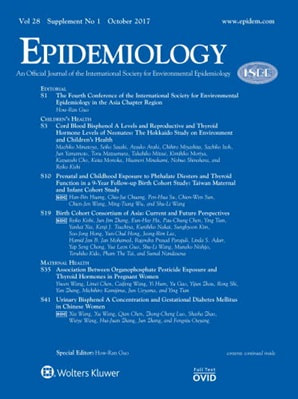
Congrats for BiCCA profile paper published in Epidemiology: Birth Cohort Consortium of Asia: Current and Future Perspectives.
|

|
Announcement Oct 2, 2017
Congrats for two ongoing collaborative research projects proposed by Taiwan Maternal and Infant Cohort Study (TMICS) and Growing up in Singapore Towards Health Outcomes (GUSTO).
|
|
Prenatal perfluorooctanoic acid exposure is associated with early onset atopic dermatitis in 5-year-old children.
Hui-Ju Wen, Shu-Li Wang, Yu-Chen Chuang, Pau-Chung Chen, Yue Leon Guo. Chemosphere. 2019 231:25-31 https://www.sciencedirect.com/science/article/abs/pii/S0045653519310045 |
|
Comparative epidemiology of gestational diabetes in ethnic Chinese from Shanghai birth cohort and growing up in Singapore towards healthy outcomes cohort. Evelyn Xiu Ling Loo, Yuqing Zhang, Qai Ven Yap , Guoqi Yu , Shu E Soh , See Ling Loy, Hui Xing Lau , Shiao-Yng Chan, Lynette Pei-Chi Shek , Zhong-Cheng Luo, Fabian Kok Peng Yap, Kok Hian Tan, Yap Seng Chong, Jun Zhang, Johan Gunnar Eriksson. BMC Pregnancy and Childbirth. 2021 21:566. https://bmcpregnancychildbirth.biomedcentral.com/articles/10.1186/s12884-021-04036-5
|
|
The effect of portable HEPA filter air cleaner use during pregnancy on fetal growth: The UGAAR randomized controlled trial. Prabjit Barn, Enkhjargal Gombojav, Chimedsuren Ochir, Buyantushig Boldbaatar, Bolor Beejin, Gerel Naidan, Jargalsaikhan Galsuren, Bayarkhuu Legtseg, Tsogtbaatar Byambaa, Jennifer A. Hutcheon, Craig Janes, Patricia A. Janssen, Bruce P. Lanphear, Lawrence C. McCandless, Tim K. Takaro, Scott A. Venners, Glenys M. Webster, Ryan W. Allen. Environ Int. 2018 Sep. Available online.
|
|
Science of The Total Environment VSI: Asian Birth Cohorts
Edited By Adrian Covaci, Kyungho Choi, Reiko Kishi and Yankai XIA Developing fetuses and infants are exposed to and affected by myriads of chemicals. Exposures during early life stages may influence the health of later stages of life and even that of the next generations. Therefore, understanding the exposure profiles and their linkage with adverse health effects are important tasks of environmental health sciences. It is very challenging but highly rewarding task in environmental health sciences and management. Asia is unique in that many historic/cultural backgrounds are shared, which may influence the pattern of chemical exposure. At the same time, Asia includes diverse ethnic groups and many countries with different levels of development, and economic status. Therefore, understanding the exposure profiles and the effects of a given country does not only help addressing outstanding environmental health challenges of the given country, but also assist in better understanding and resolving the public health concerns of other countries with similar characteristics. Dozens of prospective birth cohorts have been designed and maintained in Asia, which include government-funded large cohorts as well as more research-oriented smaller sized ones. These cohorts have generated significant amounts of new knowledge about temporal and spatial profiles of exposure, possible sources of chemical exposure, potential risks associated with the exposure, and links with adverse health effects, etc. These experiences have helped other researchers in the design of new prospective birth cohort programs. In order to understand recent progresses in birth cohort studies of Asia and to promote active communication and collaboration among the current and future studies, a special issue dedicated to major accomplishments of birth cohorts in Asia is proposed. Contains articles from 07 October 2017 to 01 April 2018 http://www.sciencedirect.com/science/journal/00489697/vsi/105NJHXQBT4 |

|
Birth Cohort Consortium of Asia: Current and Future Perspectives. Kishi R, Zhang JJ, Ha EH, Chen PC, Tian Y, Xia Y, Tsuchiya KJ, Nakai K, Kim S, Hong SJ, Hong YC, Lee JR, Jan Mohamed HJB, Parajuli RP, Adair LS, Chong YS, Guo YL, Wang SL, Nishijo M, Kido T, Tai PT, Nandasena S. Epidemiology. 2017 Oct;Suppl 1:S19-S34.
|
|
Associations of prenatal and early childhood mercury exposure with autistic behaviors at 5years of age: The Mothers and Children's Environmental Health (MOCEH) study. Ryu J, Ha EH, Kim BN, Ha M, Kim Y, Park H, Hong YC, Kim KN. Sci Total Environ. 2017 Dec;605-606:251-257.
|
|
Anthropometric measures at birth and early childhood are associated with neurodevelopmental outcomes among Bangladeshi children aged 2-3 years. Lee JJ, Kapur K, Rodrigues EG, Ibne Hasan MOS, Quamruzzaman Q, Wright RO, Bellinger DC, Christiani DC, Mazumdar M. Sci Total Environ. 2017 Dec;607-608:475-482.
|